Important!
These notes are from old SOL study material
Traditions of Political Theory: Liberal, Marxist, Anarchist, and Conservative
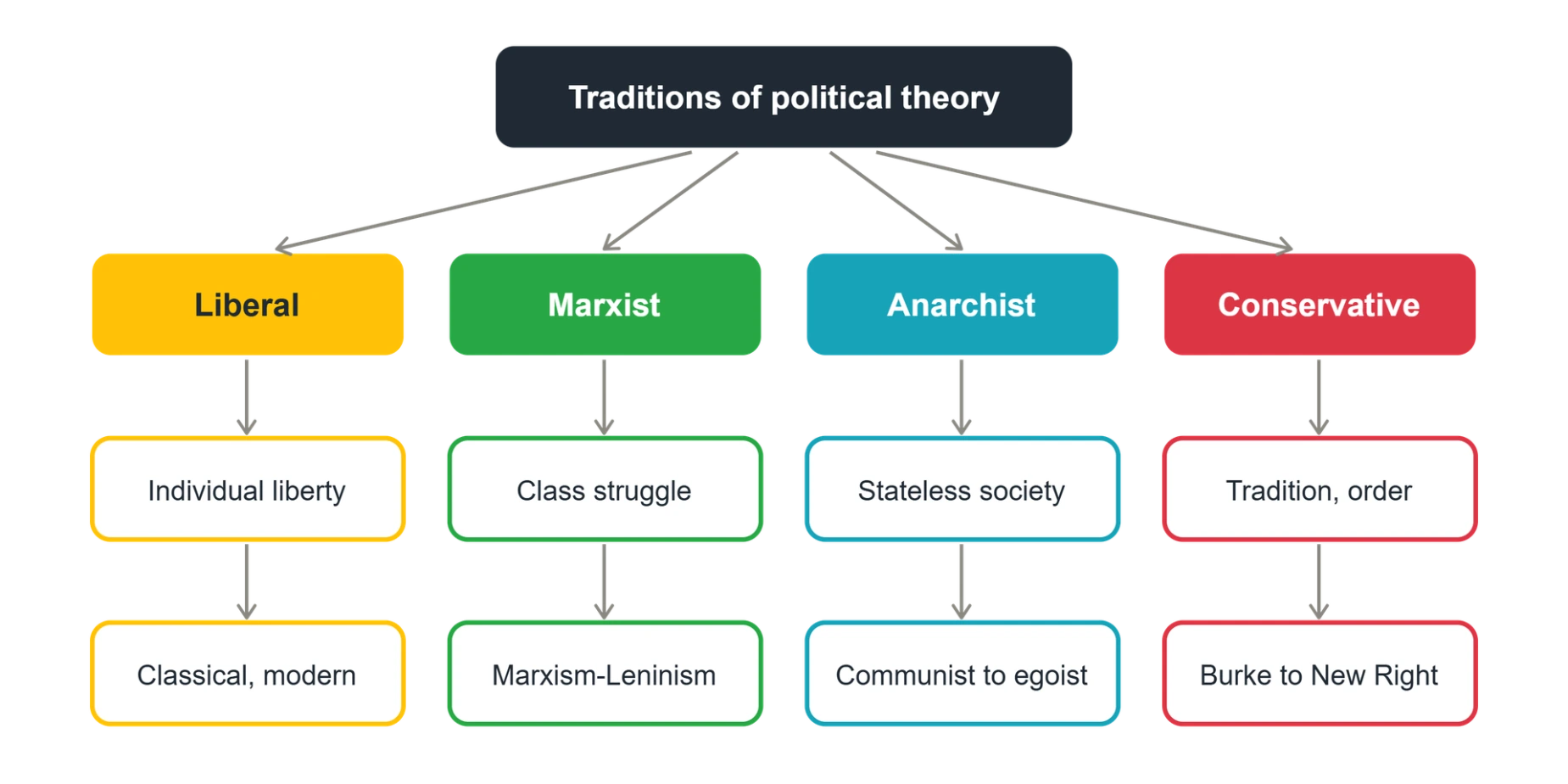
Liberal Tradition
History and Definition
The liberal tradition of political theory comes from the Latin word "liber,” which represents the class of free people. Liberalism emerged during the 17th and 18th centuries in Western Europe. It represented the ideas of individual freedom and private property rights and limited the power of the government. Liberalism challenged the absolute power of the monarchy and challenged the hierarchical division of power. The pillar of liberalism is to protect the individual from the tyranny of the government. The development of liberalism as a political idea was also a result of the industrialization happening in Europe during the 19th century. Industrialization offered economic mobility to a certain section of society that was previously not in a position to assert its rights. It opened doors to a rising middle class that was previously not involved in the decision-making process. It was largely influenced by the Enlightenment, which supported the values of universal reason and the personal autonomy of human beings.
The key features of liberalism include individualism, freedom, reason, justice, and tolerance.
Individualism: The idea of liberalism puts the individual at the center of analysis; it sees the individual as a unique entity with unique attributes specific to them and at the same level as the others. Liberalism revolves around the idea that individuals should have the autonomy to develop their potential to the maximum extent possible.
Freedom: The idea of freedom or liberty is the unifying force of the entire liberal ideology. It puts emphasis on personal rights and freedom, personal autonomy, and the protection of civil liberties. But the liberal tradition does not endorse the freedom of an individual which harms the freedom of others. John Stuart Mill terms this principle as the harm principle; he divides every action as self-regarding or other-regarding. Self-regarding allows an individual to enjoy absolute freedom, and other-regarding restricts the freedom of an individual.
Reason: The liberals believe that every individual has the ability and should be free to think rationally and decide or pursue their best interests. Liberals are strongly against the values of paternity, which is an authority that takes decisions and is modelled on the relationship of father and child. The second pillar of reason is the idea of progress and advancement; the power of reason gives the individual the capacity to transform their lives and create their own destiny. The third pillar is the knowledge to free the individual from superstition and prejudice. The fourth pillar is the use of negotiation and debate to resolve a conflict; the use of violence is only justified for self-defense, countering oppression, and defending one’s liberty. This is only when one has exhausted the capacity to reason and argue.
Justice: The tenets of justice for liberals are based on the idea that individuals have equal moral worth. The second tenet of justice is the idea of equal citizenship, i.e., each citizen is entitled to equal rights and liberties. The third tenet of liberal justice is the idea of equality of justice; the idea is that every individual must have equal opportunities to develop their unique skills and abilities.
Toleration: Toleration is built on the fact that every individual may have different opinions, genders, castes, religious inclinations, sexualities, etc. Every individual must be free to pursue their interests. John Locke, for example, defended the rights of individuals to pursue his or her religion without the interference of the state.
The Liberal State
Liberals firmly believe that the law and governance are an important part of society to prevent individuals from exploiting each other in the name of freedom. The freedom of one person should not be a license to abuse another; freedom must therefore be exercised within the limits of the law. Here the idea of a liberal state comes in. As John Locke puts it, “Where there is no law, there is no freedom.” Thus the idea of a social contract as proposed by John Locke and Thomas Hobbes comes in, where an individual gets into a contract with the sovereign state whose purpose is to defend the individual’s life and liberty in exchange for the individual following the laws and obeying the government.
The social contract theory is based on two major premises: one, that the political authority is elected by the people, and two, that the state acts as a neutral referee or an umpire in society.
The liberal state follows the idea of constitutionalism, where the government achieves its legitimacy and power from an agreed-upon set of laws and principles that are consensually agreed upon by the citizens. This is to prevent potential tyranny from the government so it works within the limits and boundaries of the constitution.
The Schools of Liberal Tradition
Classical liberal tradition
The classical liberal tradition came into being during the transition from feudalism to capitalism, mainly in the United States of America and the United Kingdom. It believes in a ‘minimal state’ with a limited function of maintaining law and order. The classical liberal tradition subscribes to ideas like individualism or egotism, i.e., individuals are self-interested. It emphasizes individual rights and autonomy, asserting that individuals are equal, intelligent, and capable of determining their own decisions of what is good. The second concept is negative liberty, in which the individual is free of all restrictions; classical liberalism focuses on maximizing negative liberty. The third concept is that the state is a necessary evil, i.e., it is required to provide conditions for existence, but it imposes a collective will on the individual.
Some tenets of classical liberalism are:
Natural Rights: According to John Locke and Thomas Jefferson, natural rights are provided by God to human beings and thus cannot be violated by anyone. Locke believes that in the state of nature, people enjoy certain rights, like the right to property, life, and liberty, and the main objective of the government should be to protect these rights. Thomas Jefferson admires natural rights and once said, “That government is best which governs least.” For him, the minimum governance means the maximum realization of natural rights.
Utilitarianism: It was developed by Jeremy Bentham and JS Mill and was viewed as a moral philosophy. The standard definition of utilitarianism is “That action is best which produces the greatest happiness for the greatest number.” Its relevance can be seen as:
Firstly, the justifiability or non-justifiability of an action can be judged by its ability to promote happiness for the masses. When moving towards making an economic, social and political decision, the outcome should be to promote the betterment of the society as a whole.
Secondly, an individual is the best judge of what is good or what is bad for him because he is rational and reasonable and to do something against his will or opinion is unjustified.
Thirdly, a government should never ignore the opinion of individuals while adopting a policy.
Economic Liberalism: Economic liberalism means the complete independence of the economy or laissez-faire. Adam Smith and David Ricardo endorsed the idea of freedom of market; they believed that the forces of supply and demand are enough for regulating the market.
Economic liberalism says that it should never be the policy of the government to regulate or obstruct economic activities.
Neoliberalism or Neoclassical Liberalism: Neoliberalism is defined as the economic ideology with minimal to no government control or spending in the economy, whether done with good intention or not. The best solution for good economic growth would be self-help, individual responsibility and entrepreneurship. It supports the total rule of the market with total freedom of movement of goods, capital and services, cutting the government expenditure for social services including education and healthcare, deregulation and privatization by selling the state-owned enterprises to private investors.
Social Darwinism: Social Darwinism was developed by Darwin in his ‘The Origin of the Species (1859).’ It states that every individual has their own ability and should be free to develop it; nothing should be imposed on them. Thus supporting survival of the fittest.
Modern Liberal Tradition
The modern liberal tradition came into being in North America and England during the late nineteenth century due to the limitations of an open market economy and minimal state. The unrestricted market and freedom of an individual led to the spread of slums, poverty, ignorance, and disease instead of creating an equally just society. Modern liberalism subscribes to certain ideas that make it different from classical liberalism, like the idea of individuality, Individuality is the self-realization of an individual’s unique identity or qualities that distinguish one person from others. According to J.S. Mill, liberty did not just mean the absence of constraints but also a positive and constructive force (state) where an individual can take control of their destiny and achieve self-realization. The second idea is the idea of positive freedom. T.H. Green criticized the negative character of freedom; he believed that the pursuit of unrestricted profits was responsible for growing poverty, income inequalities, and wealth, because of which the state cannot play the role of an onlooker. It must play a positive role in alleviating poverty and misery. Modern liberals adopted the idea of social liberalism, where the minimal state was to be replaced by a welfare state to provide various welfare schemes like healthcare, education, etc. for the social welfare of its citizens. The third tenet of modern liberalism is the idea of economic management. Modern liberals criticized the idea of laissez-faire and replaced it with Keynesian doctrine, which was named after John Maynard Keynes. J.M. Keynes, in his ‘The General Theory of Employment, Interest and Money,' argued that the policy of laissez-faire was responsible for huge joblessness; thus, governments could manage their economies by influencing the levels of aggregate demand through tax and spending policies.
Marxist Tradition
Marxism as a political tradition was introduced by Karl Marx and Friedrich Engels in the 19th century to form a classless society where workers are appreciated for their work and the output is used for the common good of the society. Marxism can be divided into three disciplinary fields:
an economic and political program
Theory of history
Philosophical anthropology
Marxism throughout history was interpreted and adapted by various socialist movements; there is Soviet Marxism influenced by the work of Vladimir Lenin and Joseph Stalin under the name of Marxism-Leninism that led the Russian Revolution of 1917. Offshoots of Marxism are adapted by scholars like Leon Trotsky under the name Trotskyism and Mao Zedong under the name Maoism in China.
Historical Materialism
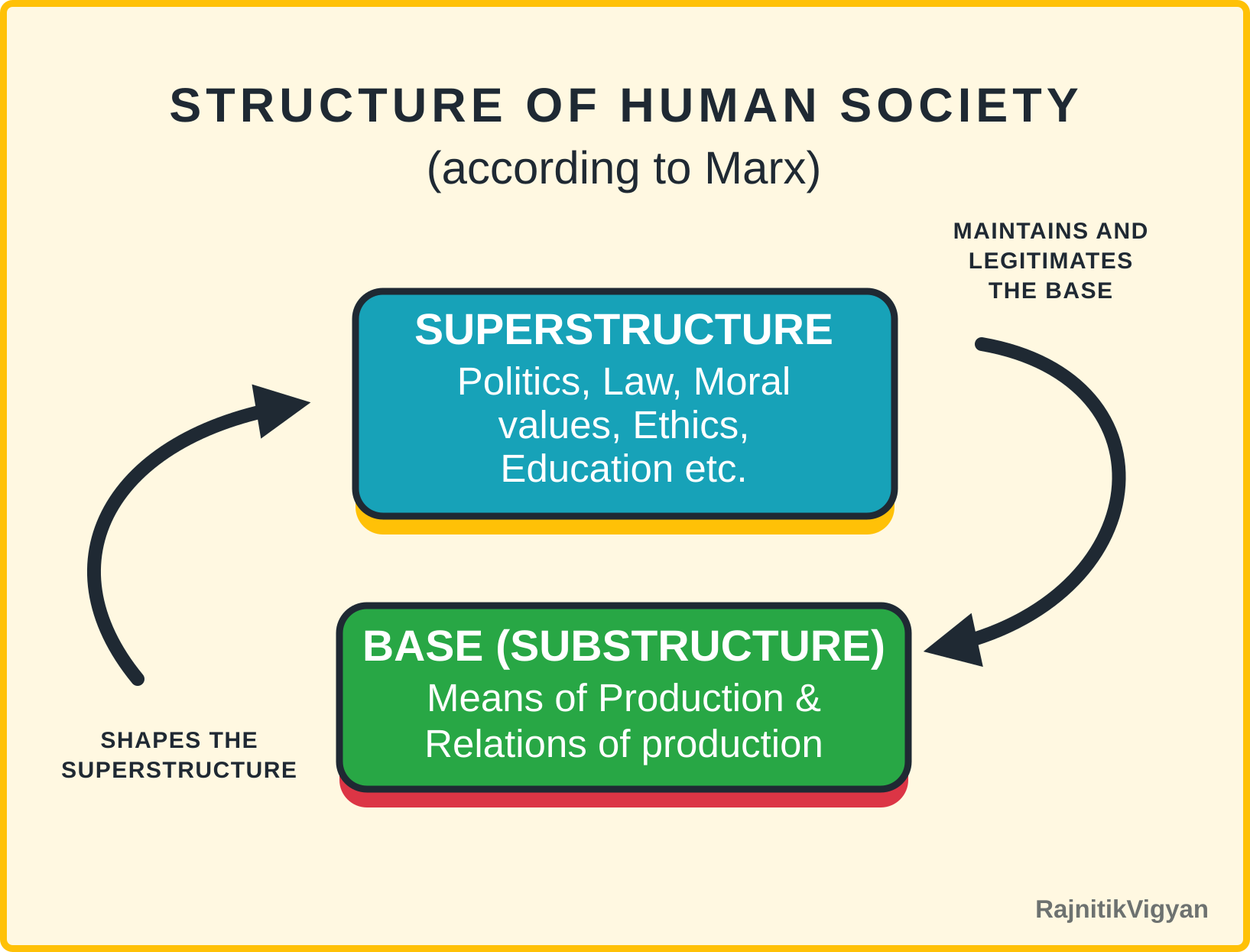
Marxian philosophy emphasizes the role of economic factors in shaping history and society. According to Marx, it is the economic position that determines the socio-political position in society. It establishes two major points:
The basic structure of the society is the economic structure, which consists of
The material forces of production, that is, labour and the means of production and
The overall “production relation,” which refers to the social and political institutions that control production and distribution.
A superstructure arises from this economic base, consisting of legal and political “forms of social consciousness” that correspond to the economic foundation. One’s political and social ideology, consciousness, and location are all determined by one’s economic base, which Marx refers to as a class. This economic foundation, or 'class,’ lies at the center of Marx’s school of thinking.
Class Struggle
The idea of class or class struggle is at the center of Marxian analysis, where Marx states that “the history of all existing society is the history of class struggle." The class struggle begins when the two opposite classes have a standoff, which gives rise to a new societal structure that is based on the resulting economic order. Therefore, the class struggle is expressed in a dialectical nature.
Two classes are opposed to each other through various points in history: the owners of the production (the bourgeoisie), who are the oppressing class and the workers (the proletariat), who are the oppressed class.
In the hunting-gathering stages, there was no private property; hence, there were no classes.
In ancient history, there were slave owners who were the oppressing class and slaves who were the oppressed class.
In the Feudal period, the landowners were the oppressing class and serfs were the oppressed class.
During the capitalist period, it is the bourgeoisie and the proletariat; in the socialist period, the oppressing class would be the state managers and the workers would be the oppressed, and eventually communism will come into being and there will be no classes in society.
Alienation
Alienation comes from the Latin word alienare, which means to remove or take away.
Alienation means separation or detachment from things to which we are naturally tied, like social affairs and human nature.
Alienation occurs when an individual feels disconnected or separated from their work or surroundings.
In a capitalist world, the workers are compelled to sell their labour to the capitalists and lose control over it and their labour simply becomes a means to the end of capitalists. Workers also have no control over the product of their labor. Their labour also does not belong to them. They also become alienated from their own self and own nature and from other human beings and their work.
Types of Alienation
Alienation for Marx is of four types
Alienation from the product of the labor: Under the capitalist system, the worker instead of crafting the products from the initial idea to completion, The product is entirely directed by someone else. The product and work are highly specific in nature, is repetitive and workers are part of only one aspect of a larger production line. Thus, the final product does not feel like the worker’s own and is creatively unrewarding making it an alien object for the worker that only produces it for the means of wages and survival.
Alienation from the process of labor: Under the capitalist system, the work is directed by the employer. Workers must work as and when their employer requires instead of having the freedom to choose how and when they work. They also must complete the task set by their employer, making the process of labour external to the worker. The process of labor is directed against the worker as if it ‘does not belong to them.’ While the process of labor is not physically forced upon them, it is forced in the sense that it becomes non-voluntary.
Alienation from the self: According to Marx, work is an essential part of being a human. Since workers feel alienated from the product and the process, it is not satisfying for them. Since under the capitalist system, the work is repetitive and unsatisfying, the worker gets alienated from themselves since the work is no longer a joy but simply a means to earn wages. The worker is reduced to just one component in the production line under the capitalist system and is viewed and treated not as a human but as a replaceable element of a system.
Alienation from other workers: In a capitalist economy, laborers compete with one another to obtain better jobs, superior products, and larger profits. This creates competition between workers to sell their labour for the lowest price. Alienation fosters a false consciousness, preventing people from seeing and understanding their shared experiences and developing class consciousness.
Table: Four types of Alienation
| Type | Meaning |
|---|---|
| From the product | The worker doesn’t own or control what they make |
| From the process | Work is directed by the employer, not chosen |
| From the self | Work becomes a means of wages, not a source of joy |
| From other workers | Competition blocks class consciousness |
How to overcome Alienation
According to Marx, changing perception to overcome alienation is not enough; rather, a complete reorganization of society is required.
Marx predicted that because of the continued exploitation of the workers by the capitalists, there would be a proletariat revolution that would put an end to the capitalist system and bring about communism.
This proletariat revolution is a social revolution that would overthrow the capitalist bourgeoisie by the working-class laborers. The workers will eventually revolt due to the worsening working conditions, low wages, and continued exploitation by the capitalists and will eventually bring in a classless communist society.
In a communist society, there would be shared resources, wealth, and no social classes. Since a communist society would be without private property, it can be assumed that the workers would have control over their work that would lessen the feeling of alienation.
State and Revolution in Marxist Tradition
Marx's ideology emphasizes that the liberal state enslaves the men in society to achieve its goals, and it must be abolished or crushed for common men to be free.
Marx writes in the communist manifesto, “Political power is just the organized power of one class for dominating another.” He also writes, “The executive of the contemporary state is merely a committee for administering the common concerns of the whole bourgeoisie.”
The social contract theory as a basis for state formation was viewed with skepticism by Marx, Engels, and their followers, particularly Lenin. They adopted a mechanical approach to the origins, stressing that although the state is a human construct, it is based solely on the influence of material circumstances, which they referred to as economic circumstances, and lacks any emotion or idea.
They have classified society’s evolution into four categories: ancient communist society (primitive stage), the slave system, the feudal system, and the industrial society (capitalist society). There was no state in the communist state because of no private property. The private property system served as a catalyst for the emergence of the state. Where the state came to defend the private property.
For Marxists, the state will fade away with the communist revolution. People will be able to move to a radical transformation of their position through revolution after they realise their loss and alienation. This revolution will pave the way for the return of liberty and the foundation of communism.

Criticism
The class system is more complex:
The Marxist view of society divides the society into two classes: the bourgeois, the elite capitalists who own the means of production and the proletariats, the working class that is the oppressed class.
There is no clear-cut division of classes in today’s society; the social class is much more complex, and it is not simply divided into two classes. There are different levels of wealth in the society, hence making several social classes.
Marx’s theory completely ignores other factors of social inequality like race, color, gender, and religion.
Moreover, there exists a huge middle class that the Marxian thinkers predicted would disappear with the advancement of capitalism and merge with the proletariat class. But the opposite has happened; the middle class strengthened its position and increased in size.
Narrowing of the capitalist class:
Marx also predicted the shrinking of the capitalist class, but here again, the opposite has happened. Instead of shrinking, the base of the capitalist class has been enlarged.
Marx predicted the accumulation of capital, but there has been the dispersal of capital.
The actual working condition of the proletariat has not deteriorated. Thus, the actual working of the capitalist system has proved the Marxist theory of classes to be wrong.
Capitalism would lead to its collapse:
Marxists had predicted that the inherent contradictions of capitalism would lead to its collapse. But this has not happened so far. The advanced capitalist system has survived and has proved its resilience.
It is the socialist system that has collapsed in various parts of the world.
Capitalism has the tremendous capacity for adaptation.
Economic forces are not immune:
The Marxian theory of economic determinism has been severely criticized. It is not only the economic factor that is important to bring social change but other factors like polity, society, culture, etc., are important as well.
If economy determines polity, society, morality, value system, etc., then economy itself is shaped by these. It is a two-way process.
Economic forces are not immune to the influences of polity, society, culture, religion, values, norms, etc.
If the substructure influences the superstructure, then the superstructure also shapes the substructure. Thus, the theory of economic determinism cannot be accepted.
Later, Marxist thinkers like Gramsci accepted the important role of the superstructure.
No chance of the state withering away:
The Marxian concepts of dictatorship of the proletariat and communism are flawed.
The proletarian revolution was intended for the proletariat to seize the state apparatus from the bourgeois.
Communism envisioned the state becoming redundant and gradually withering away.
Contrary to this vision, the state became all-powerful in socialist society.
Instead of weakening, the state consolidated its position and shows no signs of fading away.
The Marxian ideal of a stateless society remains unrealized.
The state will continue to play a leading role in both socialist and communist societies.
It is unlikely the state will ever become obsolete or be relegated to history.
Communism didn’t work in real life:
According to Marx, nothing is permanent and everything changes. Feudalism changes to capitalism; capitalism would become communism, but after the overthrow of the bourgeoisie and the establishment of communism, the process of alteration halts, and the proletariats enjoy an eternal state of utopianism, and communism would not be transferred into anything else.
History has proved Marx and his predictions wrong that communism would be the final state of affairs.
The communist revolution in Eastern Europe after World War II did not lead to greater equality and freedom as Marx would have hoped. The collapse of the
Berlin Wall in 1989 marked the end of communism in Eastern Europe and the gradual shift of ex-Soviet bloc countries to capitalist systems. The shift of China to a more open market economy is another proof that communism does not work in real life.
Anarchism
Anarchy comes from the Greek word ‘Anarkhos,’ which means ‘without rule.’ It was first used in a negative form during the French Revolution to discredit protestors. Anarchism popularly means chaos and disorder.
Anarchism believes that the state is both evil and unnecessary; they believe in the idea of a stateless society through the abolition of law and government, with the core value given to unrestricted personal autonomy. Anarchists argue that authority, particularly in the form of the state, is inherently coercive and corrupting, and they seek to replace it with voluntary associations and self-governance. It was first used in a positive sense by Pierre-Joseph Proudhon in his book ‘What is Property?’.
Definition:
Anarchism is a political philosophy that advocates for a society without hierarchical structures or centralized authority, promoting self-governed communities based on voluntary cooperation and mutual aid. Anarchists believe in the abolition of the state, capitalism, and other forms of coercive power, envisioning a society where individuals have personal autonomy and decision-making power. Anarchism encompasses various schools of thought, including anarcho-communism, anarcho-syndicalism, and individualist anarchism, each with its own approach to achieving a stateless society.
Core themes of anarchism are:
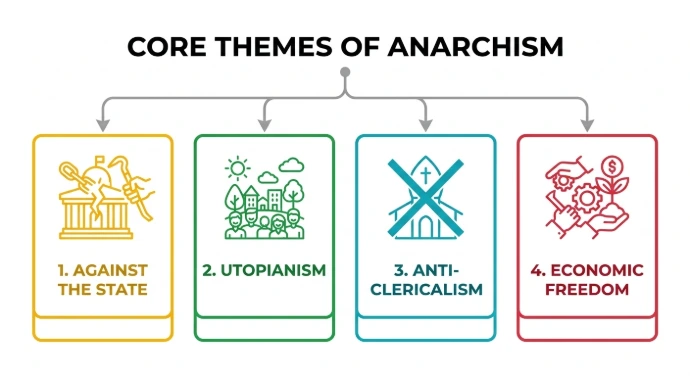
Against the State/Anti-Statism
Anarchism’s central belief is the opposition of the state hierarchy or any form of government and law. Anarchists endorse the idea of a stateless society in which free individuals manage their affairs by voluntary agreement without coercion and compulsion.
Authority, according to anarchists, is opposed to absolute freedom and unrestrained political equality.
According to anarchists, authority gives one person the right to influence the behavior of others, enslaves, oppresses, and limits human life.
Anarchism as a doctrine is based on two accounts:
First is the assumption that moral assertion is stronger in individuals than analysis and explanation. Anarchists believe that human beings are morally good and are drawn to freedom and autonomy, rather than to analyzing how to challenge the oppressive system.
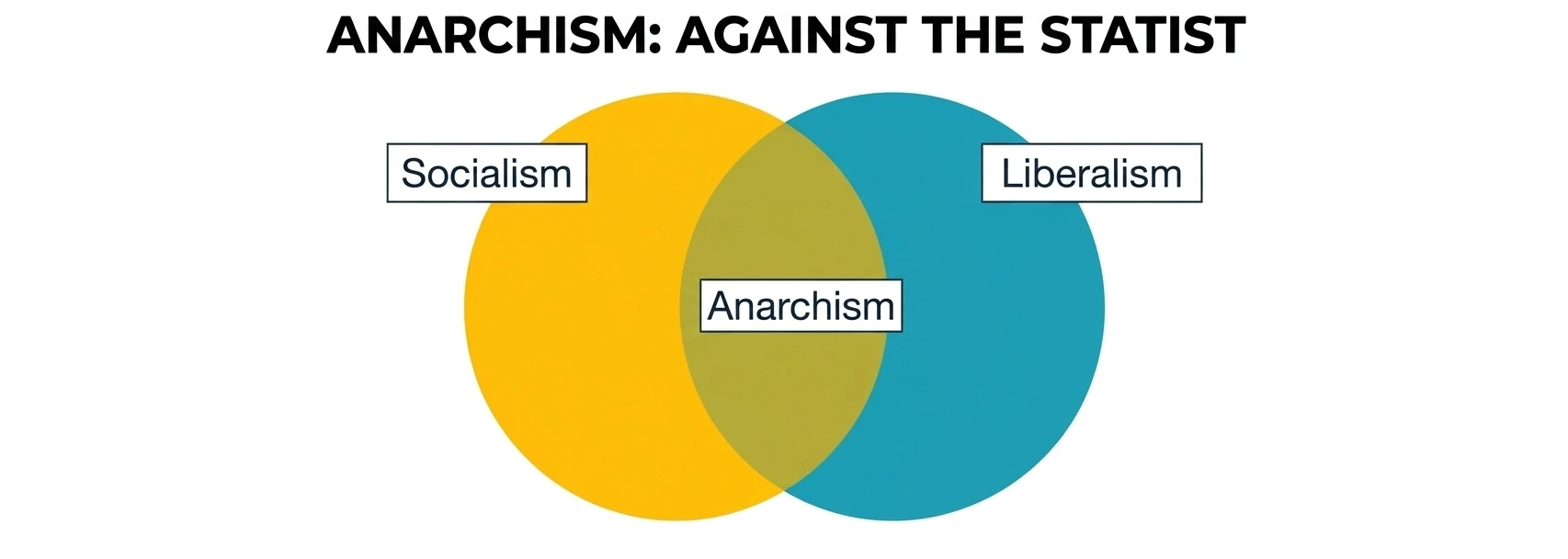
Secondly, anarchism is a less coherent theory and more of a midpoint between two other political traditions, i.e., ultra-liberalism, because it puts a lot of emphasis on extreme liberal individualism and ultra-socialism because it put a lot of emphasis on extreme socialist collectivism.
Utopianism
A utopia is a society that is ideal, perfect, or close to perfect with no violence, oppression, or conflict of any kind. Utopian theories, like anarchism or marxism, are often seen as deluded or fanciful thinking, a belief in unrealistic and unachievable goals.
Anarchists believe in a society without a state or any kind of hierarchy because they believe that a state is the cause of all the problems in men’s lives and men from its core are morally good and are rational creatures. It is often seen as a utopian theory.
Anti-Clericalism
As the state has been the primary target of the anarchists, the same criticism applies to any other form of authority. Indeed, anarchists have shown the same bitterness towards church as they have toward the state, particularly in the nineteenth century.
Many anarchists view organized religion as a form of hierarchical authority that oppresses individuals and restricts their freedom. The idea of God as the supreme being who commands ultimate and unquestionable authority. An anarchist political philosophy had to be based on the rejection of Christianity, because only then could human beings be regarded as free and independent.
Anarchists speculate that religious and political authority go hand in hand. Anarchists believe that the abolition of the church and the state must be the first and indispensable condition of the true liberation of society.
Anarchists view religion as one of the pillars of the state: it propagates an ideology of obedience and submission to both spiritual leaders and earthly rulers. Earthly rulers have often looked to religion to legitimize their power.
Finally, religion seeks to impose a set of moral rules onto the individuals and to establish the code of acceptable behavior. Religious belief requires conformity to standards of good and evil, which are defined and policed by figures of religious authority such as imams. Robbing the individual of moral autonomy and the capacity to make ethical judgments.
Economic Freedom
Besides the anti-state nature of anarchism, anarchists have also been interested in challenging the structures of social and economic life. Bakunin argued that ‘political power and wealth are inseparable.' In the nineteenth century, anarchists usually worked with the working class movement and related to the broadly socialist philosophy.
Bakunin identified three social groups in every developed society: a vast majority who are exploited; a small minority who are exploited but also exploit others in equal measure and ‘a ruling class,' including kings and princes, politicians and state officials, judges and police officers, and bishops and priests, as well as industrialists and bankers, that exploits and oppresses ‘the masses.'
Hence, nineteenth-century anarchists identified themselves with the poor and oppressed and sought to carry out social revolutions in which both state and capitalism would be swept away.
Branches of Anarchism
Table: Branches of Anarchism
| Branch | Key idea | Key name |
|---|---|---|
| Anarcho-communism | Common ownership, small self-managing communes | Kropotkin |
| Anarcho-syndicalism | Revolutionary trade unions, general strike | France and Spain |
| Mutualism | Fair exchange, mutual credit banks | Proudhon |
| Individualist anarchism | Self-ownership, no collective power | Godwin, Stirner |
| Libertarianism | Maximum freedom through reason or market exchange | Thoreau, Tucker, Warren |
| Anarcho-capitalism | Free market replaces the state | Rothbard, Rand, Friedman |
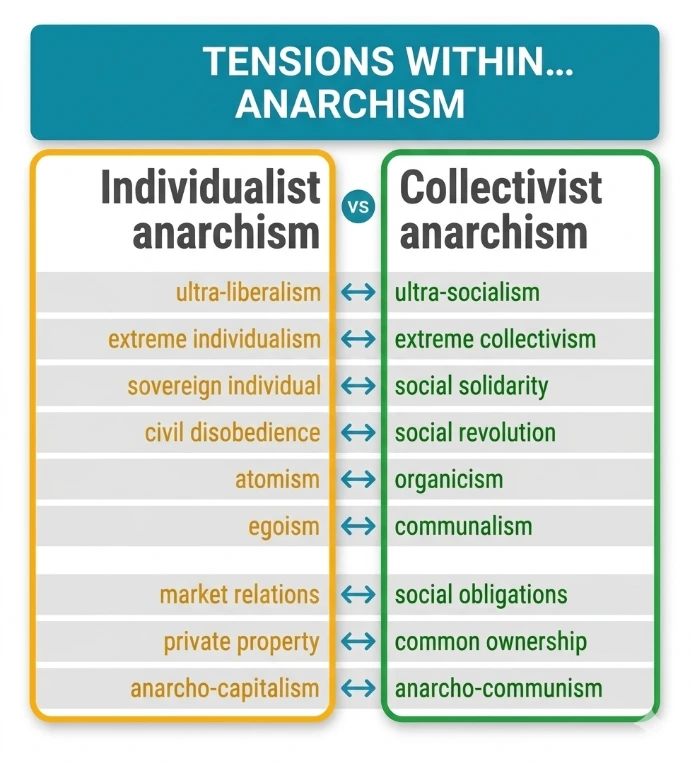
Image: Tensions within Anarchism: Individualist Anarchism vs Collectivist Anarchism
Anarcho-communism
Anarcho-communism, or Communist Anarchism, advocates for the common ownership and the abolition of the private ownership of property.
Anarcho-communists admire small, self-managing, and self-sufficient communities, each owning its wealth in common.
Egalitarianism and the elimination of social hierarchy and class differentiation are central to anarchy-communism.
The communal organization of social and economic life has three advantages:
First, as communes are based on the principles of sharing and collective endeavor, they strengthen the bonds of compassion and solidarity and keep selfishness and greed in check.
Second, within the communes the decisions are made through the process of direct democracy, which guarantees a higher level of popular participation and political equality. Popular self-government is the only form of government that would be acceptable to anarchists.
Third, as communes are small-scale communities, it will allow people to manage their affairs through face-to-face interaction. In the anarchist view, centralization is always associated with depersonalization and bureaucratic social processes.
Anarcho-syndicalism
Anarcho-syndicalism is another name for collective anarchism. Syndicalism is a form of revolutionary trade union, drawing its name from the French word syndicat, meaning "group" or "union." Syndicalism is based on socialist ideas.
It first emerged in France, then its ideas spread to Italy, Latin America, the USA, and most importantly to Spain.
Syndicalists see workers and peasants as the oppressed class, and industrialists, landlords, politicians, judges, and the police are portrayed as oppressors or exploiters.
Workers defend themselves by organizing syndicates or unions, based on particular crafts, industries, or professions. In the short term, these syndicates act as conventional trade unions, raising wages, shortening hours, and improving working conditions. However, syndicates are also revolutionaries who look forward to the overthrow of the capitalist government and seizure of power by the workers.
While syndicalist theories were confused and unsystematic, they nevertheless exerted strong attraction from anarchists who wanted to spread their ideas to the masses.
Two features of syndicalists that inspired anarchists are:
First, syndicalists rejected conventional politics as corrupting and pointless; they believed working-class power should be exerted through direct action, boycotts, strikes, and sabotage, and ultimately a general strike.
Second, anarchists saw syndicates as the model for the decentralized, non-hierarchic society of the future.
Syndicates typically exhibited a high degree of grassroots democracy and formed federations with other syndicates, either in the same area or the same industry.
Although anarcho-syndicalism enjoyed genuine mass support, at least until the Spanish Civil War, it failed to achieve its revolutionary goals. Beyond the rather vague idea of general strike, anacho-syndicalism failed to develop a proper political strategy or a theory of revolution.
Other anarchists have criticized syndicalism for focusing on short-term trade union goals and therefore leading anarchism away from revolution and towards reformism.
Mutualism
A system of fair and equitable exchange, in which individuals or groups bargain with one another, trading goods and services without profiteering or exploitation (basically a barter system).
Developed by Pierre Proudhon, mutualism advocates for cooperation and a society where individuals and groups can freely exchange goods and services, promoting harmony and opposition to competition and state control.
Proudhon’s followers tried to put his ideas into practice by setting up small mutual credit banks in France and Switzerland, which provided cheap loans for investors and charged a rate of interest only high enough to cover the cost of running the bank and not high enough to make a profit.
Individualist Anarchism (or Libertarian Anarchism)
Individual anarchism (also known as anarcho-individualism) put the emphasis on individual ownership over collective ownership.
Individualist anarchism is a branch of anarchism that prioritizes the rights and freedoms of the individual above all else. It emphasizes personal autonomy, self-ownership, and freedom from all coercive institutions.
Individualist anarchism believes that type of collective entity or public power will only result in individual tyranny. In this context, individualism coincides with liberalism, especially negative liberalism that puts individual sovereignty at the center.
William Godwin (1756 - 1836) argued for an extreme version of individualist anarchy, urging the abolition of all forms of labor collaboration.
Max Stirner (1806 - 1856), one of the first and most well-known proponents of individualist anarchism, suggested an extreme egoist variant of it, which supports the person doing precisely what he wants without regard for God, state, or moral norms.
Although individual anarchism coincides with liberalism, significant differences exist between them:
First, while liberals accept the idea of individual liberty, they do not believe in a stateless society. Liberals argue that a nightwatchman state is necessary to ensure that self-interested individuals do not harm the other by theft, intimidation, violence, or even murder. Law, therefore, exists to protect freedom and not to constrain it. Anarchists, on the other hand want to abolish the state completely because they see it as corrupt and pointless. They believe that individuals can conduct themselves peacefully and harmoniously without the need of the ‘police’. Anarchists differ themselves from liberals because they believe that free individuals can live and work together constructively because they are rational and moral creatures.
Second, liberals believe that the power of the government can be controlled by the development of the constitution and more representative institutions. The Constitution claims to protect individuals by limiting the power of the government and creating checks and balances among its various institutions. Regular elections are conducted to make the government more accountable towards the general public or at least a majority of the electorate. Anarchists, on the other hand, believe that all laws violate individual liberty, whether the government that enacts them is arbitrary or constitutional, democratic or dictatorial. They completely dismiss the idea of limited, constitutional, or representative government. In other words, all states are an offense against individual liberty.
Egoism
Inspired by the German philosopher Maw Stirner, who was deeply influenced by Hegel. Egoism is an extreme form of individualist anarchism.
Stirner’s theories represent an extreme form of individualism.
The term “egoism” suggests that individuals are concerned about their ego or self. They are self-interested or self-seeking.
Self-interestedness can, however, generate conflict among individuals and justify the existence of the state to restrain each self-interested individual from harming or abusing others.
In Stirner’s view, egoism is a philosophy that puts the individual self at the center of the moral universe. The individual, as per his perspective, should simply act as per his or her choices, without the consideration of laws, society, religion, or moral values.
Libertarianism
Libertarianism is a belief that an individual should enjoy the wildest possible realm of freedom; it implies the removal of both internal and external constraints upon the individual.
Libertarianism was developed by libertarian thinkers like Henry David Thoreau, Lysander Spooner, Benjamin Tucker, and Josiah Warren.
Benjamin Tucker explained how autonomous individuals could live and work together with one another without the danger or conflict. Two possible solutions are available to individualists for this problem.
The first emphasizes human rationality and suggests that when conflicts occur, they can be resolved by reasoned discussion.
The second solution is to develop some kind of mechanism through which independent actions of autonomous individuals could be brought into harmony with one another. This could be achieved through a system of market exchange. Warren believed that individuals have the right to the property they themselves achieve but are also forced to work with others by economic logic in order to gain the advantages of the division of labor. He suggested that this could be achieved by a system of labour-for-labour exchange and setting up ‘time stores’ through which one person’s labour could be exchanged for a promise to return labour in kind.
Anarcho-Capitalism
Anarcho-capitalism is a radical form of individualist anarchism that believes in the abolition of the state or minimal state, free-market economics, individual sovereignty, and property rights. They argue that all services, including law and security, could be provided by voluntary and competing businesses.
Developed by right-wing libertarians such as Robert Nozick, Ayn Rand, Murray Rothbard, and David Friedman.
Robert Nozick revived the idea of a minimal state, whose principal function is to protect individual rights. Other thinkers, for instance Ayn Rand, Murray Rothbard, and David Friedman, pushed the boundaries of the free market to their limit and argued that the government can be abolished completely and be replaced by unregulated market forces. They argue that the property should be owned by a sovereign individual who, if they wish to, may enter into a contract with others in the pursuit of self-interest. Thus the individual and the market remain free beyond the control of any single or group.
There are some disagreements among anarcho-capitalists about the idea of free markets. Some anarcho-capitalists go well beyond the idea of a free market. Some believe that the market is an effective and efficient mechanism for providing most of the goods, but argue it has its own limits. Some services, like maintenance of domestic order, the enforcement of contracts, and protection against external threats, are ‘public goods’ that should be provided by the state because they cannot be supplied by the private market competition.
Anarcho-capitalists like Rothbard believe that the market can fulfill all human wants. He believed that in an anarchist society individuals will seek protection from each other, and such protection can be delivered completely by privately owned ‘protection associations’ and ‘private courts’ without the need of a police force or court system.
Indeed, anarcho-capitalists believe profit-making protection agencies would offer better services than the current police force because competition would provide consumers with a choice, ensuring that agencies are cheap, efficient, and responsive to consumer needs. Similarly, private courts would be forced to develop a fair reputation in order to attract custom from the individuals wishing to resolve the conflict, and most importantly, unlike the public authorities, the contracts made with private agencies will be entirely voluntary and regulated only by impersonal market forces.
Such proposals may sound radical, but the policy of privatization has already been followed in western states like the USA, the UK, and even in India. In the USA, many states have already started to use private prisons, and in the UK, private prisons and the use of private protection agencies have become common.
Roads to Anarchy
In terms of political strategy, anarchism confronts the problem that if the state is evil and oppressive, any attempt to acquire, win, or influence the government power must be corrupting and unhealthy.
Political power acquired by any means, whether through representative democracy (ballot paper) or at the point of the gun, is oppressive.
Similarly, anarchists are disappointed by political parties, both parliamentary and revolutionary, because they are bureaucratic and hierarchic organizations.
Thus, the idea of an anarchist government, an anarchist political party, or an anarchist politician would therefore be contradictory.
There is no conventional ‘road to anarchy,’ but anarchists have explored less orthodox means of political activism. Some of them are:
Revolutionary violence
The nineteenth century saw anarchist leaders provoking the oppressed masses to insurrection and revolt. For example, Michael Bakunin led a conspiratorial brotherhood, the Alliance for Social Democracy, and took part in anarchist risings in France and Italy.
By the end of the nineteenth century, many anarchists had turned their attention to the revolutionary potential of the syndicalist movement, and by the end of the twentieth century, the anarchist movement had lost its momentum and support to the better organized and more tightly disciplined communist movement.
Nevertheless, some anarchists continued to place emphasis on the revolutionary potential of terrorism and violence. Anarchist violence has been prominent in two periods: in the late nineteenth century, reaching its peak in the 1890s, and again in the 1970s.
Anarchists have employed terrorism or clandestine violence to create an atmosphere of terror, often by using bombing or assassinations.
In the anarchist view, violence is a form of revenge or retribution. Violence originates in the oppression and exploitation that politicians, judges, industrialists, the police, and others inflict onto the working class. Anarchist violence thus merely mirrors the everyday violence of society and directs it towards those who are really guilty. Considering it as a form of ‘revolutionary justice.’
In addition, anarchists consider violence as a way of raising political consciousness and stimulating the masses to revolt.
However, in reality, anarchist violence has opposite conclusions.
Instead of awakening the masses to the reality of their oppression, political violence has received public backlash and provoked public horror and outrage, resulting in the state responding with more repressive machinery with the backing of public opinion.
Direct Action
Direct action may refer to passive resistance or terrorism against an existing society. Anarcho-syndicalists, for example, refused to engage in conventional, representative politics and preferred instead to exert direct pressure on employers by boycotting their products, sabotaging machinery, and organizing strike action.
From the anarchist point of view, direct action has two advantages:
First, it is beyond the reach of the process of the government and the machinery of the state. Political discontent and opposition can therefore be expressed openly and honestly without being diverted in a constitutional direction and cannot be managed by professional politicians.
Second, it can be organized on the basis of decentralization and participatory decision-making.
The clear influence of anarchism can be seen in the new social movements (such as feminist, environmental, gay rights, and anti-globalization movements) to engage in this form of anti-political politics.
Direct action has some of its drawbacks, like that it may damage public support because it leaves groups and movements that employ direct action open to the charge of irresponsibility or extremism.
Although direct action attracts media and public attention, it may restrict political influence because it defines the group or movement as a political outsider that is unable to gain access to the process of public policy-making.
Non-violence or Anarcho-pacifism
Pacifism refers to the commitment to peace and a rejection of war or violence in any circumstances. 'Pacific' is a Latin word that means ‘peace-making.’
Anarchists like Godwin and Proudhon did not like violent principles and were attracted to the principles of non-violence and pacifism developed by the Russian novelist Leo Tolstoy and Mahatma Gandhi. Although neither of them can be classified as anarchists.
Tolstoy, in his political writings, developed the image of a corrupt and false modern civilization. He suggested that salvation could only be achieved by living according to the religious principles and living a simple, rural lifestyle based on the lifestyle of the Russian peasantry.
Gandhi campaigned against racial discrimination. His political method was based on the idea of satyagraha, or non-violent resistance, influenced both by the teachings of Tolstoy and Hindu religious principles.
The principle of nonviolence has appealed to anarchists for two reasons:
First, it reflects a respect for human beings as moral and autonomous creatures, who are entitled to be treated with compassion and respect.
Second, to refrain from the use of violence, especially when subjected to intimidation and provocation, demonstrates the strength and moral purity of one’s conviction.
Key Figures in Anarchism
William Godwin

Source: Wikipedia
William Godwin (1756-1836) was a British philosopher and novelist.
He developed a comprehensive critique of authoritarianism, representing early anarchist beliefs.
Godwin's philosophy was influenced by the Enlightenment view of human nature as rational and perfectible.
He believed that education and social conditioning would enable humanity to achieve self-government.
According to Godwin, the increasing capability for self-government would eliminate the need for government, along with associated issues like war, poverty, crime, and violence.
His chief political work is "Enquiry Concerning Political Justice," published in 1793.
Josiah Warren

Source: Wikipedia
Josiah Warren (1798–1874) was a US individualist anarchist, inventor, and musician.
He was a founding member of the New Harmony experimental community in Indiana.
Warren advocated for the principle of 'sovereignty of the individual'.
He proposed a system of 'equitable commerce', recognizing labor as the only legitimate form of capital.
His system aimed to eliminate both poverty and excessive luxury.
Warren's Cincinnati Time Store is often regarded as the first experiment in mutualism.
Key writings by Warren include "Equitable Commerce" (1852) and "True Civilization" (1863).
Max Stirner

Source: Wikipedia
Max Stirner (1806-1856) was a German philosopher.
He developed an extreme form of individualism based on egoism.
Stirner condemned all checks on personal autonomy.
Unlike other anarchists who emphasized moral principles like justice, reason, and community, Stirner focused solely on the 'ownness' of the individual.
He placed the individual self at the center of the moral universe.
Stirner's thinking influenced Friedrich Nietzsche and later laid a foundation for existentialism.
His most important political work is "The Ego and His Own," published in 1845.
Pierre-Joseph Proudhon

Source: Wikipedia
Pierre-Joseph Proudhon (1809-1865) was a French social theorist, political activist, and largely self-educated printer.
His writings had a significant influence on many nineteenth-century anarchists, socialists, and communists.
Proudhon's best-known work is "What Is Property?" published in 1840.
In this work, he attacked both traditional property rights and collective ownership.
He argued istead of mutualism, a cooperative productive system focused on need rather than profit, organized within self-governing communities.
In "The Federal Principle" (1863), he argued that these communities should interact based on 'federal' compacts.
He suggested that this federal state would have minimal functions.
Mikhail Bakunin

Source: Wikipedia
Mikhail Bakunin (1814-1876) was a Russian political agitator and revolutionary.
He was a key proponent of collectivist anarchism.
Bakunin emerged as a leading figure within the nineteenth-century anarchist movement.
He argued that political power is intrinsically oppressive.
Bakunin placed his faith in human sociability as a means to achieve freedom.
He proposed that freedom could only be achieved through 'collectivism'.
His concept of collectivism involved self-governing communities based on voluntary cooperation.
Bakunin advocated for the absence of private property and rewards that reflect individual contributions.
He extolled the 'sacred instinct of revolt' and held a fiercely anti-theological stance.
Henry David Thoreau

Source: Wikipedia
Henry David Thoreau (1817-1862) was a US author, poet, and philosopher.
His writings significantly impacted individualist anarchism and the environmental movement.
Thoreau was a follower of transcendentalism.
His major work, "Walden," published in 1854, described a two-year 'experiment' in simple living.
In "Walden," Thoreau emphasized the virtues of self-reliance, contemplation, and closeness to nature.
In "Civil Disobedience," published in 1849, he defended conscientious objection to unjust laws.
Thoreau emphasized that government should never conflict with individual conscience.
He did not explicitly advocate for anarchy in his writings.
Peter Kropotkin

Source: Wikipedia
Peter Kropotkin (1842–1921) was a Russian geographer and anarchist theorist.
His work embodied a scientific spirit, proposing an alternative theory of evolution to Darwin's.
Kropotkin emphasized 'mutual aid' as the principal means of development for humans and animals.
He sought to provide an empirical basis for both anarchism and communism.
Kropotkin advocated for reconstructing society based on self-management and decentralization.
His major works include:
"Mutual Aid" (1902)
"The Conquest of Bread" (1892)
"Fields, Factories, and Workshops" (1898)
Murray Rothbard

Source: Wikipedia
Murray Rothbard (1926-1995) was a US economist and libertarian thinker.
He advocated for 'anarcho-capitalism,' combining extreme Lockean liberalism with Austrian School free-market economics.
Rothbard viewed the right of total self-ownership as a 'universal ethic.'
He argued that economic freedom is incompatible with governmental power.
Rothbard became a fierce opponent of the 'welfare-warfare' state.
He championed non-intervention in both domestic and foreign affairs.
Key writings by Rothbard include:
"Man, Economy, and State" (1962)
"For a New Liberty" (1978)
"The Ethics of Liberty" (1982)
Anarchism in a global age
Revival through Libertarian Tendencies: Anarchism influenced movements such as the New Left and New Right during the 1960s and 1970s. The New Left focused on student activism, anti-colonialism, liberation, personal fulfillment, and activist-based politics, while the New Right also emphasized individual freedom supported by market competition, as seen in anarcho-capitalist thought.
Challenges to Statism: Anarchism provided a counter to statist tendencies in other ideologies like socialism, liberalism, and conservatism by emphasizing the coercive and destructive nature of political power.
Anti-Capitalist Protest in the 1990s: The rise of anti-capitalist activism saw a resurgence of anarchist influence. Contemporary anti-capitalist movements often identify explicitly as anarchists, reversing the earlier dominance of Marxism as the leading radical left-wing thought.
Critique of Global Capitalism: Anarchism's focus on autonomy, participation, decentralization, and equality made it effective in critiquing global capitalism's imprint on societies worldwide.
Direct Action and Activism: A hallmark of modern anarchism is its emphasis on protest and direct action, illustrated by events such as the 1999 "Battle of Seattle" when some 50,000 activists forced the cancellation of the opening ceremony of the World Trade Organization.
Appeal to Youth Activists: Anarchism's rejection of compromise, hierarchies, and consumerism resonates with young anti-capitalist activists, offering a more spontaneous, "in-the-moment" form of politics.
Theoretical Contributions: Thinkers like Noam Chomsky have linked anarchism to resistance against globalization, critiquing entrenched power and hegemonic ambitions, particularly those of the USA.
Criticism of anarchism:
Anarchism as an 'Impulse' or 'Sensibility': Modern anarchism is seen more as a loose, instinctive reaction rather than a cohesive ideological system. It does not align with traditional anarchist thinkers or engage in earlier debates, such as those between anarchists and Marxists on strategy and organization.
Shift in Focus, Lack of Critique: Although the focus of anarchism has moved from opposing the state and industrial capitalism to challenging global capitalism, a distinctively anarchist critique of globalization has not fully materialized, even in works like Noam Chomsky's.
Eclectic and Fragmented Nature: Within the diverse and fragmented anti-capitalist movement, the anarchist element itself is eclectic and lacks a theoretical core. Modern anarchism tackles a range of issues—environment, consumerism, gender, and global inequality—potentially broadening its appeal but reducing its political effectiveness.
Vision and Strategy Shortfall: While anarchism sustains the idea of a better, alternative world, it offers few concrete ideas on how such a world could function or strategies for achieving it.
Conservative Tradition
- Conservatism is a political tradition that opposes or is cautious of change. It is characterized by preserving the existing order.
Conservatism stems from a desire to conserve other existing orders and resist any changes to the same.
It was first used in the United States of America to imply a pessimistic state of affairs.
The group of people who were opposed to the French Revolution was also deemed to be conservatives. In the United Kingdom, conservatives came to be known as "Tory," which later became one of the two political parties.
It was Edmund Burke who stated deep regret over the changing state of affairs in France during the French Revolution in his Reflection on the Revolution in France.
He considered that the destruction of the ancient regime was one of the worst atrocities in the history of mankind.
The idea of conservatism was placed defensively against the rapidly changing social order in the 19th century.
Throughout Europe and the Western world, there have been differing trends toward conservatism. In the UK, conservatism has been linked to the readiness to "change in order to preserve."
The early 20th-century authoritarian conservatism that dominated Europe, particularly in Germany and Italy, only changed after World War II when conservative political parties began to embrace the concepts of social reform and political democracy.
The resilient character of conservatism is perhaps found in the fact that it is one of the most intellectually modest of political ideologies. Ironically, it has been changing continuously throughout political history. The two most notable examples are the new right that emerged under Margaret Thatcher in the United Kingdom and Ronald Reagan in the United States.
The first challenge in understanding conservatism is that it is simpler to comprehend what they oppose. The second issue is that defining conservatism also runs the risk of making conservatives themselves angry. Instead of viewing conservatism as a clear-cut ideology, they would rather consider it a state of mind.
Core Tenets of Conservatism
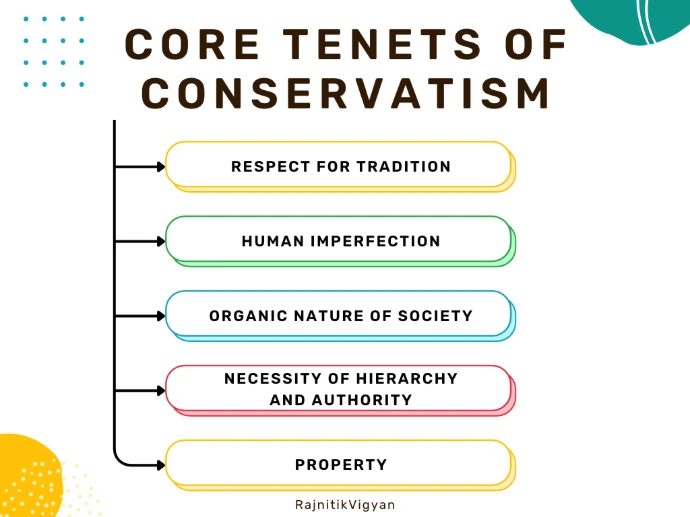
Respect for Tradition:
The major pillar for conservative tradition is its defense of tradition, which can be a religious faith, social order or even a form of authority.
Edmund Burke defined a social order based on all three—in terms of religion, he stated that our society is shaped by “the laws of our creator”; similarly, in terms of society, Burke said we should see ourselves in a “partnership with those who are living, those who are dead, and those who are to be born.”
A tradition for conservatives is a repository of the wisdom of the past. The logic is that the values that have survived have done so because they survived the test of time and therefore must not be tempered with.
Tradition also provides an individual with a sense of identity, rootedness and belonging.
An example can be the monarchy in the UK that exists solely because it provides a focus on national loyalty.
Human Imperfection:
Conservatives support the idea that people are flawed and can change at any time. The conservative view of humans is that they are dependent, psychologically limited beings who fear isolation and instability.
They are drawn to what is “known.” Their need for security drives them to pursue a social structure that guarantees stability in an uncertain world.
They subscribe to the Hobbesian view of human nature, which is inherently selfish and greedy. Crime exists in society because of human nature, and only order can prevent people from giving in to their violent and self-centered tendencies.
In addition, conservatives believe that human intellect is limited and that the world is too complex for humans to comprehend; therefore, ideas must be grounded in something that is known; in the case of conservatives, that is tradition.
Organic nature of society
According to conservatives, humans are incapable of living without a society because they are security-seeking creatures. The purpose of the social order is to support the individual, and society is what gives life purpose.
For conservatives , freedom cannot be viewed negatively; rather, it is the voluntary acceptance of social responsibilities and bonds by people who are aware of their own values. For conservatives, being free means fulfilling one's obligations. Conservatives hold to the organicism theory, which holds that society is a living thing, much like an organism.
With a society like an organism, the whole is more than the collection of parts. And it can “stay alive” if each part fulfills its assigned part or duty. An organic society comes into being naturally, which comes into being with natural social impulses such as love, caring, and responsibility. This view of society has some relevant implications; if society is organic, its structures and institutions have been shaped by forces that are not in human control. Hence, it must not be tampered with.
Necessity of hierarchy and authority
Conservatives claimed that hierarchy and inequality are unavoidable aspects of society. This means that achieving real society equality in terms of position, money or power is an unattainable goal.
There are some similarities between liberalism and conservatism in this regard. While liberals see inequality as a compromise that must be accepted to accommodate differences in likes or talents among people, conservatives see it as something deeper that is important for society's function—in other words, something that should be understood positively.
Conservatives have insisted that it must be accepted that some should lead while others follow, some should control while others work and some should go out to earn a living while others stay at home to raise children. This is based on the belief that everyone has their own natural place and function in society.
The Conservatives' interest in authority strengthens their belief in hierarchy and the inevitability of inequity. Conservatives see power as a natural entity that already exists and is imposed on us from "above,” much like society itself.
Conservatives do not think that the subject of the authority must give their consent in order to exercise legal power. Since the person in charge must provide guidance, support, and assistance to those who lack the ability, expertise, or experience to make their own decisions, this is said to be pointless.
The conservative viewpoint does not view authority from "above" as a bad thing. Instead, it is thought to contribute to social stability by giving people a sense of what is expected of them. Additionally, it is asserted that discipline is encouraged by having a clear authority.
Conservatives are known for being cautious of efforts to challenge governmental authority because of these factors.
In fact, nineteenth-century authoritarian conservatives, who view all forms of political authority as absolute, would find this to be totally unacceptable.
Property
Conservatives attach great importance to the concept of property. They believe there are a number of benefits to owning private property or assets.
Like many liberals, conservatives believe that property ownership is a sign of merit; that is, that a person's ability to accumulate a sizable fortune or property is the consequence of his will to work hard throughout his life and make good use of his skills.
However, a lot of conservatives believe that there are more social and psychological advantages to owning a property.
First possession of property ensures financial security. Second, it is argued that a society that enables private property ownership drives its citizens to follow the law and behave lawfully.
Types of Conservatism
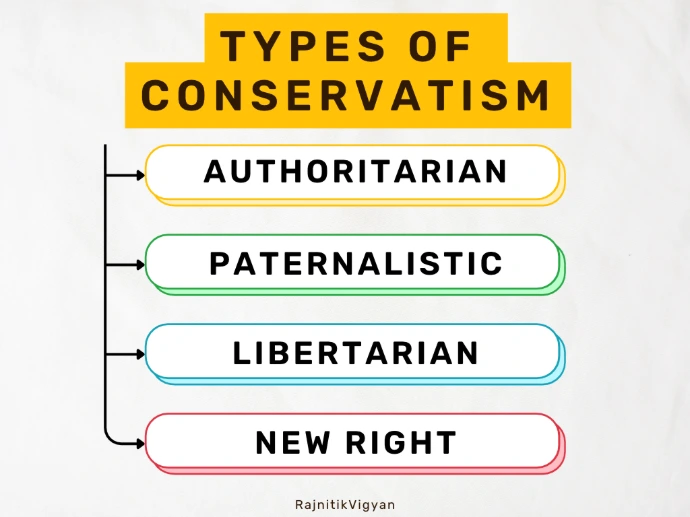
Table: Types of Conservatism
| Type | Key idea | Example |
|---|---|---|
| Authoritarian | Order and absolute authority | de Maistre, Tsar Nicholas I |
| Paternalistic | Reform to avoid revolution | Disraeli (One Nation), Christian Democracy |
| Libertarian | Economic freedom plus social conservatism | USA |
| New Right | Free market plus tradition | Hayek, Friedman, Thatcher, Reagan |
Authoritarian Conservatism
The tradition that has supported authoritarian rule, particularly in Europe, is the source of authoritarian conservatism.
Joseph De Maistre was the harshest critic of the French revolution and one of the most ardent supporters of the French monarchy. The Du Pape supported the notion in his text that the Pope has a higher spiritual authority than earthly rule. He advocated for maintaining order because he believed that without it, society would descend into anarchy and oppression.
Tsar Nicholas I of Russia established the ideals of "orthodoxy, autocracy, and nationality," which is another instance of authoritarian governance.
Paternalistic Conservatism
Paternalistic conservatism has its roots in the Anglo-American tradition, which was influenced by Edmund Burke, who maintained that change should not be opposed if it is inevitable and natural.
This conservative approach is characterized by caution, modesty, and pragmatism. Only in real-world situations can conservative values be upheld. There are two strands of paternalistic conservatism:
One Nation conservatism: The principles of this kind of conservatism were established by British Prime Minister Benjamin Disraeli in his writings of Sybil (1845) and Coningsby (1844). These books were more concerned with the idea of social responsibility than with extreme individualism. Disraeli’s ideas can be best summed up as prudent and principled. According to him, Britain was in danger of splitting into two countries: the rich and the poor. The seeds of revolution would be found in social inequality. Therefore, reform would be wise to avoid a major revolution. Disraeli also made an argument about the morality of acquiring wealth and privilege, which must be accompanied by a social duty to help the less fortunate and impoverished. This concept came to be known as One Nation.
Christian Democracy: Many Christian democratic parties implemented interventionist policies following World War II. The Christian Democratic Party in Italy and the Christian Democratic Union in West Germany were the two most important of these parties. Many conservatives gave up their authoritarian stances and embraced Catholicism's paternalistic social traditions after the war. Catholic theory emphasizes social harmony and balance over rivalry and social groups over individuals. To emphasize the value of intermediary institutions like churches, unions, and business associations—all of which are connected by the idea of social partnership—democratic corporatism was promoted.
Libertarian Conservatism
Libertarian conservatism, also referred to as conservative libertarianism, is a political theory that combines libertarianism and conservatism, with the conservative wing being represented by libertarian conservatism and vice versa.
Libertarian conservatism, which adheres to a more socially conservative worldview that emphasizes authority, morality, and responsibility, advocates for maximum economic liberty and minimal government control over social life, much like laissez-faire classical liberalism.
Originating in the United States, libertarian conservatism emphasizes liberty, rejecting liberal social engineering and promoting free speech, choice, and free-market economics to accomplish conservative objectives.
Libertarian conservatism can also be described as strengthening civil society through conservative institutions and authority, such as family, country, church, and education, as part of the libertarian movement to reduce governmental power.
New Right
Theorists contend that economic and political liberty can be attained through the free market. The fundamental ideas of the New Right ideology can be found in the writings of American economists Milton Friedman and Hayek.
Although the new right is "new," it does not mean that their opinions have never been heard before. In fact, they closely resemble the issues of liberal philosophy in the nineteenth century and are greatly influenced by Adam Smith. They can only be characterized as "new" in contrast to the "old right's" concerns with tradition, moderation, and support for the postwar political consensus.
Both Hayek's 1960 book, The Constitution of Liberty, and his early 1940s book, The Road to Serfdom, were directed at what he referred to as "state socialism." Hayek linked central planning of the economy to socialism.
However, he asserts that only in the proper social and moral context can market processes operate effectively. He does this by highlighting the value of tradition in transmitting the collective wisdom and experience of previous generations, which is ironically reminiscent of "old right" thinking.
The theoretical underpinnings of the attack on trade union strength are found in Friedman's examination of the presumed tradeoffs between higher inflation and lower unemployment.
Such tradeoffs are only feasible in the short term, according to Friedman.
The equilibrium real wage at which the amount of labor supplied voluntarily equals the amount of labor employed voluntarily by businesses over an extended period of time is the "nonaccelerating inflation rate of unemployment" (NAIRU), also referred to as the "natural rate of unemployment."
This means that any natural rate of unemployment is structural and frictional.
Friedman argues that the latter can only be distributed by removing the institutions that hinder the labor supply and reducing the natural rate.
Trade union authority is therefore specifically targeted because it keeps unemployed people from agreeing to work for less than the natural rate of pay.
Only by reducing this power will the labor market become more competitive and the natural rate of unemployment fall.
Key Figures in Conservatism
David Hume

Source: https://en.wikipedia.org/wiki/David_Hume
David Hume's Life: Scottish philosopher, historian, and economist (1711–1776), a key figure in the Scottish Enlightenment. His early philosophical work was A Treatise of Human Nature, later revised as An Enquiry Concerning Human Understanding and An Enquiry Concerning the Principles of Morals. Also a successful historian with The History of England.
Core of his conservatism: Rooted in skepticism about abstract human reason and an emphasis on experience, tradition, and custom as the foundations of a stable society.
Key Contributions to Conservatism:
Skepticism of Abstract Reason: Wary of grand rationalistic schemes for societal reorganization, believing they would lead to instability due to ignoring complex human nature and established customs.
Emphasis on Custom and Tradition: Viewed customs and traditions as accumulated wisdom providing a stable framework for social life and order.
Importance of Experience: Asserted that knowledge and societal functionality come from experience, favoring gradual change over radical reforms.
Role of Sentiment and Habit: Recognized that humans are driven by passions and habits, requiring institutions and customs to channel these constructively.
Implicit Critique of Social Contract Theory: His emphasis on custom and convention as the basis of political obligation contrasts with theories based solely on rational consent.
Support for Established Institutions: Provided a philosophical defense for existing institutions and gradual societal evolution, opposing revolutionary upheaval.
Overall Approach: A pragmatic and cautious approach to political and social change, valuing historical lessons and the stability of tradition over abstract reason and radical reform.
Edmund Burke

Source: https://en.wikipedia.org/wiki/Edmund_Burke
Edmund Burke's Life: Irish statesman, orator, and political theorist (1729–1797). Served in the British House of Commons. A leading figure in the Whig party, known for his opposition to the French Revolution and support for the American colonies. His most famous work is Reflections on the Revolution in France (1790).
Core of his conservatism: A pragmatic conservatism rooted in a profound skepticism of radical change and a deep respect for tradition, prescription, and organic social development.
Key Contributions to Conservatism:
Rejection of Abstract Reason and Rights: Criticized the French Revolution's reliance on abstract philosophical principles and universal natural rights, arguing that such ideas ignore the complexities of human nature and society.
Emphasis on Tradition and Prescription: Believed that society is an organic entity that evolves over generations, and traditions represent the accumulated wisdom and experience of past ages. He argued that these inherited institutions and customs have a prescriptive authority, meaning their long existence validates their value.
Organic Society: Viewed society not as a collection of isolated individuals but as a living organism, with interdependent parts working together. This implied that sudden, radical changes would disrupt the delicate balance and lead to chaos.
Prudence and Gradual Reform: Advocated for cautious, incremental change driven by practical experience rather than abstract theories. He believed that reforms should be undertaken only when necessary and should aim to preserve the existing order, not dismantle it.
Importance of Prejudice and Institutions: Argued that "prejudice" (in the sense of inherited wisdom and instinctive loyalties) and established institutions (like the church, family, and aristocracy) provide stability and moral guidance, tempering human passion and preventing anarchy.
Critique of Revolution: Saw revolution as a destructive force that tears down established order, leading to tyranny and disorder rather than liberty. He particularly condemned the French Revolution for its violence, atheism, and attempt to remake society from scratch.
Role of Property and Hierarchy: Supported the sanctity of private property and recognized the natural existence of social hierarchies, viewing them as essential for order and stability.
Michael Oakeshott

Source: https://en.wikipedia.org/wiki/Michael_Oakeshott
Michael Oakeshott's Life: English political philosopher (1901–1990). A prominent voice in twentieth-century conservatism. Taught at Cambridge and the London School of Economics. His major works include Rationalism in Politics and Other Essays (1962) and On Human Conduct (1975).
Core of his conservatism: A philosophical conservatism emphasizing the practical, historical nature of political activity, rejecting abstract rationalism and grand ideological schemes.
Key Contributions to Conservatism:
Critique of Rationalism in Politics: Argued strongly against the idea that politics could be approached as a technical problem to be solved by applying abstract, universal principles or rational blueprints. He believed this "rationalism" led to utopianism and tyranny.
Emphasis on Tradition and Practice: Saw politics as a practical activity, like cooking or sailing, learned through experience, custom, and tradition ("knowing how" rather than "knowing that"). For Oakeshott, political wisdom is embedded in the inherited practices and traditions of a community.
"The Pursuit of Intimations": Described political change as a process of "pursuing intimations" – making small, adaptive adjustments to existing traditions and practices rather than attempting radical breaks or wholesale reconstructions.
"Civic Association" (or "Nomocracy"): Distinguished between two modes of association: "enterprise association" (where individuals are united by a common purpose or goal) and "civic association" (where individuals are bound by a common set of rules or laws, allowing them to pursue their own diverse purposes). He argued that a free society is primarily a civic association, where the state's role is to maintain the rules, not direct collective goals.
Skepticism of Ideology: Viewed ideologies as simplified, abstract summaries of more complex political traditions, arguing that they distort genuine political understanding and lead to rigid, often oppressive, policies.
Importance of Liberty as a "Non-Instrumental" Good: Liberty was understood not as a means to an end (like achieving a perfect society), but as a way of being—the freedom to pursue one's own chosen activities within a framework of known laws and customs.
Leo Strauss

Source: https://en.wikipedia.org/wiki/Leo_Strauss
Leo Strauss's Life: German-American political philosopher (1899–1973). Fled Nazi Germany, settling in the United States. Taught at the University of Chicago. His work focused on classical political philosophy and its relevance to modern thought. Key works include Persecution and the Art of Writing (1952) and Natural Right and History (1953).
Core of his conservatism: A profound critique of modern rationalism and historicism, advocating for a return to classical political philosophy and the concept of natural right as a basis for a virtuous political order.
Key Contributions to Conservatism:
Critique of Modernity: Argued that modern political thought, stemming from figures like Machiavelli and Hobbes, had rejected the classical pursuit of virtue and the "best regime" in favor of realistic, often amoral, considerations of power and self-interest. This led to a lowering of moral horizons.
Rehabilitation of Natural Right: Contended that there is an objective, discernible standard of right and wrong inherent in nature (natural right) that transcends historical relativism. He believed that modern thought's rejection of natural right led to nihilism and moral confusion.
Esoteric Writing: Proposed that many classical philosophers wrote "esoterically," meaning they conveyed deeper, often unpopular, truths to a select few discerning readers while presenting a more conventional, exoteric message to the general public. This was done to protect themselves from persecution and to protect society from potentially disruptive truths.
Classical Political Philosophy as a Guide: Believed that studying classical political philosophy (Plato, Aristotle) offers timeless insights into the human condition, the nature of justice, and the best way to live, which modern philosophy had obscured.
Distinction Between Facts and Values: Criticized the modern social sciences for their rigid distinction between "facts" and "values," arguing that this leads to a relativistic understanding of morality where all values are seen as subjective. Strauss believed that the pursuit of knowledge naturally involves understanding what is good.
Importance of Religion and Piety: While a secular thinker himself, Strauss recognized the vital role of traditional religion and shared moral beliefs in maintaining social order and fostering virtue, contrasting with what he saw as the corrosive effects of modern secularism and relativism.
Table: Comparison of all the traditions of Political Theory: Liberal, Marxist, Anarchist and Conservative
Basis | Liberal | Marxist | Anarchist | Conservative |
| Core value | Individual liberty | Class equality | Absolute autonomy | Tradition and order |
| View of the state | Necessary, limited (neutral umpire) | Class instrument; withers away | Evil and unnecessary; abolish | Natural, authoritative |
| View of human nature | Rational | Shaped by economic conditions | Morally good | Imperfect, limited |
| Property | Protected | Abolished (communal ownership) | Varies by school (communal, individual or market) | Valued (security) |
| Equality | Equal rights and opportunity | Classless society | Political equality | Hierarchy is natural |
| Key thinkers | Locke, Mill, Green | Marx, Engels, Lenin | Proudhon, Bakunin, Kropotkin | Burke, Oakeshott, Hume |
Exercise Question
Answer
1. Introduction & Conceptual Background
Meaning of Liberty: Derived from the Latin word 'Liber', meaning free or unrestricted. In political theory, it means the absence of arbitrary restraints alongside the presence of opportunities for self-development.
Isaiah Berlin's Framework: Your answer must cite Isaiah Berlin’s seminal 1958 essay, "Two Concepts of Liberty". Berlin systematized the division of liberty into two distinct political traditions: Negative and Positive.
2. Negative Conception of Liberty ("Freedom From")
Negative liberty is concerned with the "zone of non-interference." It defines an area where an individual should be left completely alone to do, be, or act without any deliberate human or state coercion.
Core Premises:
It answers the question: "Over what area am I a master?"
It views every law as a restraint on absolute individual freedom (as argued by Jeremy Bentham).
It distinguishes between "being free" and "having capacity." For example, if you lack money to buy food, a negative libertarian argues you are still "free" to buy it because no law explicitly prevents you from doing so.
Key Thinkers to Mention:
John Locke: Argued for natural rights (Life, Liberty, Property) that the state cannot violate.
J.S. Mill: In On Liberty, he divided actions into self-regarding (private actions where the state cannot interfere) and other-regarding (actions affecting others where the state can step in).
Robert Nozick & F.A. Hayek: Modern libertarians who advocate for a minimal "night-watchman" state.
3. Positive Conception of Liberty ("Freedom To")
Positive liberty goes beyond formal legal rights and focuses on the actual capacity and socio-economic opportunities available to an individual to realize their true potential.
Core Premises:
It answers the question: "Who governs me?" or "What is the source of my control?"
It views poverty, illiteracy, and unemployment as forms of unfreedom. If a student cannot afford college, they are not genuinely free to pursue higher education.
It shifts freedom from an opportunity concept (merely having an open door) to an exercise concept (having the resources to walk through it).
Key Thinkers to Mention:
Jean-Jacques Rousseau: Linked freedom with self-mastery and collective participation ("Moral Freedom").
T.H. Green: Defined liberty as a positive power of doing or enjoying something worth doing.
Karl Marx: Critiqued negative liberty as bourgeois freedom, arguing true emancipation requires removing capitalist structural inequalities.
4. Core Differences (Table for Quick Revision)
Parameter | Negative Liberty | Positive Liberty |
Nature | Absence of external constraints/coercion | Presence of enabling conditions/capacities |
Focus area | Personal domain (private sphere). | Social domain (Socio-economic context). |
Role of State | Minimal state (Laissez-faire); Law limits freedom. | Welfare state; Law expands and guarantees freedom. |
Core Slogan | "Leave the individual alone" (Freedom from). | "Empower the individual" (Freedom to). |
5. Critical Evaluation & Conclusion
Critique of Negative Liberty: It creates a "formal" freedom that favors the strong and wealthy while ignoring how structural poverty disables the marginalized.
Critique of Positive Liberty: As Isaiah Berlin warned, positive liberty carries the risk of paternalism or authoritarianism. If the state defines what your "true self" or "rational interest" is, it can force you to comply under the guise of "liberating" you.
Answer
Class Struggle
According to Marx, the history of all existing societies (except the primitive communist stage) has been the history of class struggle. The class struggle arises from antagonism between two opposite classes, the dominant class (haves) and the dependent class (have-nots). This antagonism is driven by class contradictions resulting from the exploitation of the propertyless class by the property-owning class.
Two classes are opposed to each other throughout various points in history: the owners of the production (the bourgeoisie), who are the oppressing class, and the workers (the proletariat), who are the oppressed class.
In the hunting-gathering stages (primitive stage), there was no private property; hence, there were no classes.
In ancient history (the slave system), there were slave owners (masters) who were the oppressing class, and the slaves were the oppressed class.
In the feudal period, the landowners (feudal lords) were the oppressing class, and serfs (peasants) were the oppressed class.
During the capitalist period, it was the bourgeoisie and the proletariat; in the socialist period, the oppressing class would be the state managers, and the workers would be the oppressed. Eventually, communism would come into being, and there would be classes in society.
The dominant classes (masters, feudal lords, and bourgeoisie) own the means of production, and the dependent classes (slaves, peasants, and proletariat) carry out the production, but their production is taken away by exploiters, and in return, the workers receive the bare minimum for survival, perpetuating exploitation.
The opposing interests of the dominant and dependent classes are irreconcilable. No compromise is possible between these contending classes. The contradictions and conflicts between classes can only be resolved by annihilating the exploiting class. This final resolution is a driving force for social change in history.
Answer
Criticism of anarchism:
Anarchism as an 'Impulse' or 'Sensibility': Modern anarchism is seen more as a loose, instinctive reaction rather than a cohesive ideological system. It does not align with traditional anarchist thinkers or engage in earlier debates, such as those between anarchists and Marxists on strategy and organization.
Shift in Focus, Lack of Critique: Although the focus of anarchism has moved from opposing the state and industrial capitalism to challenging global capitalism, a distinctively anarchist critique of globalization has not fully materialized, even in works like Noam Chomsky's.
Eclectic and Fragmented Nature: Within the diverse and fragmented anti-capitalist movement, the anarchist element itself is eclectic and lacks a theoretical core. Modern anarchism tackles a range of issues—environment, consumerism, gender, global inequality—potentially broadening its appeal but reducing its political effectiveness.
Vision and Strategy Shortfall: While anarchism sustains the idea of a better, alternative world, it offers few concrete ideas on how such a world could function or strategies for achieving it.
Roads to Anarchy
In terms of political strategy, anarchism confronts the problem that if the state is evil and oppressive, any attempt to acquire, win, or influence the government power must be corrupting and unhealthy.
Political power acquired by any means, whether through representative democracy (ballot paper) or at the point of the gun, is oppressive.
Similarly, anarchists are disappointed by political parties, both parliamentary and revolutionary, because they are bureaucratic and hierarchic organizations.
Thus, the idea of an anarchist government, an anarchist political party, or an anarchist politician would therefore be contradictory.
There is no conventional ‘road to anarchy,’ but anarchists have explored less orthodox means of political activism. Some of them are:
Revolutionary violence
The nineteenth century saw anarchist leaders provoking the oppressed masses to insurrection and revolt. For example, Michael Bakunin led a conspiratorial brotherhood, the Alliance for Social Democracy, and took part in anarchist risings in France and Italy.
By the end of the nineteenth century, many anarchists had turned their attention to the revolutionary potential of the syndicalist movement, and by the end of the twentieth century, the anarchist movement had lost its momentum and support to the better organized and more tightly disciplined communist movement.
Nevertheless, some anarchists continued to place emphasis on the revolutionary potential of terrorism and violence. Anarchist violence has been prominent in two periods: in the late nineteenth century, reaching its peak in the 1890s, and again in the 1970s.
Anarchists have employed terrorism or clandestine violence to create an atmosphere of terror, often by using bombing or assassinations.
In the anarchist view, violence is a form of revenge or retribution. Violence originates in the oppression and exploitation that politicians, judges, industrialists, the police, and others inflict onto the working class. Anarchist violence thus merely mirrors the everyday violence of society and directs it towards those who are really guilty. Considering it as a form of ‘revolutionary justice.’
In addition, anarchists consider violence as a way of raising political consciousness and stimulating the masses to revolt.
However, in reality, anarchist violence has opposite conclusions.
Instead of awakening the masses to the reality of their oppression, political violence has received public backlash and provoked public horror and outrage, resulting in the state responding with more repressive machinery with the backing of public opinion.
Direct Action
Direct action may refer to passive resistance or terrorism against an existing society. Anarcho-syndicalists, for example, refused to engage in conventional, representative politics and preferred instead to exert direct pressure on employers by boycotting their products, sabotaging machinery, and organizing strike action.
From the anarchist point of view, direct action has two advantages:
First, it is beyond the reach of the process of the government and the machinery of the state. Political discontent and opposition can therefore be expressed openly and honestly without being diverted in a constitutional direction and cannot be managed by professional politicians.
Second, it can be organized on the basis of decentralization and participatory decision-making.
The clear influence of anarchism can be seen in the new social movements (such as feminist, environmental, gay rights, and anti-globalization movements) to engage in this form of anti-political politics.
Direct action has some of its drawbacks, like that it may damage public support because it leaves groups and movements that employ direct action open to the charge of irresponsibility or extremism.
Although direct action attracts media and public attention, it may restrict political influence because it defines the group or movement as a political outsider that is unable to gain access to the process of public policy-making.
Non-violence or Anarcho-pacifism
Pacifism refers to the commitment to peace and a rejection of war or violence in any circumstances. Pacific is a Latin word that means ‘peace-making.’
Anarchists like Godwin and Proudhon did not like violent principles and were attracted to the principles of non-violence and pacifism developed by the Russian novelist Leo Tolstoy and Mahatma Gandhi. Although neither of them can be classified as anarchists.
Tolstoy, in his political writings, developed the image of a corrupt and false modern civilization. He suggested that salvation could only be achieved by living according to the religious principles and living a simple, rural lifestyle based on the lifestyle of Russian peasantry.
Gandhi campaigned against racial discrimination. His political method was based on the idea of satyagraha, or non-violent resistance, influenced both by the teachings of Tolstoy and Hindu religious principles.
The principle of nonviolence has appealed to anarchists for two reasons:
First, it reflects a respect for human beings as moral and autonomous creatures, who are entitled to be treated with compassion and respect.
Second, to refrain from the use of violence, especially when subjected to intimidation and provocation, demonstrates the strength and moral purity of one’s conviction.
Answer
Types of Conservatism
Authoritarian Conservatism
The tradition that has supported authoritarian rule, particularly in Europe, is the source of authoritarian conservatism.
Joseph De Maistre was the harshest critic of the French revolution and one of the most ardent supporters of the French monarchy. The Du Pape supported the notion in his text that the Pope has a higher spiritual authority than earthly rule. He advocated for maintaining order because he believed that without it, society would descend into anarchy and oppression.
Tsar Nicholas I of Russia established the ideals of "orthodoxy, autocracy, and nationality," which is another instance of authoritarian governance.
Paternalistic Conservatism
Paternalistic conservatism has its roots in the Anglo-American tradition, which was influenced by Edmund Burke, who maintained that change should not be opposed if it is inevitable and natural.
This conservative approach is characterized by caution, modesty, and pragmatism. Only in real-world situations can conservative values be upheld. There are two strands of paternalistic conservatism:
One Nation conservatism: The principles of this kind of conservatism were established by British Prime Minister Benjamin Disraeli in his writings of Sybil (1845) and Coningsby (1844). These books were more concerned with the idea of social responsibility than with extreme individualism. Disraeli’s ideas can be best summed up as prudent and principled. According to him, Britain was in danger of splitting into two countries: the rich and the poor. The seeds of revolution would be found in social inequality. Therefore, reform would be wise to avoid a major revolution. Disraeli also made an argument about the morality of acquiring wealth and privilege, which must be accompanied by a social duty to help the less fortunate and impoverished. This concept came to be known as One Nation.
Christian Democracy: Many Christian democratic parties implemented interventionist policies following World War II. The Christian Democratic Party in Italy and the Christian Democratic Union in West Germany were the two most important of these parties. Many conservatives gave up their authoritarian stances and embraced Catholicism's paternalistic social traditions after the war. Catholic theory emphasizes social harmony and balance over rivalry and social groups over individuals. To emphasize the value of intermediary institutions like churches, unions, and business associations—all of which are connected by the idea of social partnership—democratic corporatism was promoted.
Libertarian Conservatism
Libertarian conservatism, also referred to as conservative libertarianism, is a political theory that combines libertarianism and conservatism, with the conservative wing being represented by libertarian conservatism and vice versa.
Libertarian conservatism, which adheres to a more socially conservative worldview that emphasizes authority, morality, and responsibility, advocates for maximum economic liberty and minimal government control over social life, much like laissez-faire classical liberalism.
Originating in the United States, libertarian conservatism emphasizes liberty, rejecting liberal social engineering and promoting free speech, choice, and free-market economics to accomplish conservative objectives.
Libertarian conservatism can also be described as strengthening civil society through conservative institutions and authority, such as family, country, church, and education, as part of the libertarian movement to reduce governmental power.
New Right
Theorists contend that economic and political liberty can be attained through the free market. The fundamental ideas of the new right ideology can be found in the writings of American economists Milton Friedman and Hayek.
Although the new right is "new," it does not mean that their opinions have never been heard before. In fact, they closely resemble the issues of liberal philosophy in the nineteenth century and are greatly influenced by Adam Smith. They can only be characterized as "new" in contrast to the "old right's" concerns with tradition, moderation, and support for the postwar political consensus.
Both Hayek's 1960 book The Constitution of Liberty and his early 1940s book The Road to Serfdom were directed at what he referred to as "state socialism." Hayek linked central planning of the economy to socialism.
However, he asserts that only in the proper social and moral context can market processes operate effectively. He does this by highlighting the value of tradition in transmitting the collective wisdom and experience of previous generations, which is ironically reminiscent of "old right" thinking.
The theoretical underpinnings of the attack on trade union strength are found in Friedman's examination of the presumed tradeoffs between higher inflation and lower unemployment.
Such tradeoffs are only feasible in the short term, according to Friedman.
The equilibrium real wage at which the amount of labor supplied voluntarily equals the amount of labor employed voluntarily by businesses over an extended period of time is the "nonaccelerating inflation rate of unemployment" (NAIRU), also referred to as the "natural rate of unemployment."
This means that any natural rate of unemployment is structural and frictional.
Friedman argues that the latter can only be distributed by removing the institutions that hinder the labor supply and reducing the natural rate.
Trade union authority is therefore specifically targeted because it keeps unemployed people from agreeing to work for less than the natural rate of pay.
Only by reducing this power will the labor market become more competitive and the natural rate of unemployment fall.
Answer
The Liberal State
Liberals firmly believe that the law and governance are an important part of society to prevent individuals from exploiting each other in the name of freedom. The freedom of one person should not be a license to abuse another; freedom must therefore be exercised within the limits of the law. Here, the idea of a liberal state comes in. As John Locke puts it, “Where there is no law, there is no freedom.” Thus, the idea of a social contract as proposed by John Locke and Thomas Hobbes comes in, where an individual gets into a contract with the sovereign state whose purpose is to defend the individual’s life and liberty in exchange for the individual following the laws and obeying the government.
The social contract theory is based on two major premises: one, that the political authority is elected by the people, and two, that the state acts as a neutral referee or an umpire in society.
The liberal state follows the idea of constitutionalism, where the government achieves its legitimacy and power from an agreed-upon set of laws and principles that are consensually agreed upon by the citizens. This is to prevent potential tyranny from the government so it works within the limits and boundaries of the constitution.
State and Revolution in Marxist Tradition
Marx's ideology emphasizes that the liberal state enslaves the men in society to achieve its goals, and it must be abolished or crushed for common men to be free.
Marx writes in the communist manifesto, “Political power is just the organized power of one class for dominating another.” He also writes, “The executive of the contemporary state is merely a committee for administering the common concerns of the whole bourgeoisie.”
The social contract theory as a basis for state formation was viewed with skepticism by Marx, Engels, and their followers, particularly Lenin. They adopted a mechanical approach to the origins, stressing that although the state is a human construct, it is based solely on the influence of material circumstances, which they referred to as economic circumstances, and lacks any emotion or idea.
They have classified society’s evolution into four categories: ancient communist society (primitive stage), the slave system, the feudal system, and the industrial society (capitalist society). There was no state in the communist state because of no private property. The private property system served as a catalyst for the emergence of the state. Where the state came to defend the private property.
For Marxists, the state will fade away with the communist revolution. People will be able to move to a radical transformation of their position through revolution after they realise their loss and alienation. This revolution will pave the way for the return of liberty and the foundation of communism.
Table: The difference between the liberal and Marxist ideas of the state
Aspect | Liberal Tradition | Marxist Tradition |
Purpose of the State | To protect individual freedom within the bounds of law | To serve the interests of the ruling class (bourgeoisie) |
View on Freedom | Freedom must be exercised within legal limits; law enables true freedom | True freedom is impossible under capitalism; the state must be abolished for liberty |
Social Contract Theory | Central to state formation, individuals consent to be governed for protection | Rejects social contract theory, state arises from material/economic conditions, not consent |
Role of Law | Law is essential to prevent exploitation and ensure justice | Law is a tool of class domination |
Nature of Political Authority | Elected by the people; state acts as a neutral referee | Political power is organized domination by one class over another |
Legitimacy of the State | Based on constitutionalism and consent of the governed | The state is illegitimate under capitalism; it must be crushed through revolution |
Historical Evolution of the State | Not explicitly detailed in liberal theory | Evolves through stages: primitive communism → slavery → feudalism → capitalism |
Private Property | Protected by the state | The root cause of state formation is that the state defends private property |
End Goal | A constitutional state that balances freedom and law | Stateless, classless society after the communist revolution |
Key Thinkers | John Locke, Thomas Hobbes | Karl Marx, Friedrich Engels, Vladimir Lenin |